

The Old Reflex: When and How You Can Get a Google Review Removed
Wanting to get a Google review removed is the first, almost instinctive reaction of many business owners to negative feedback. The impulse is understandable: a single bad review can damage a carefully built reputation. But this reflex is often short-sighted and, as we will see, soon no longer the smartest strategy.
The First Impulse: Why the 'Remove' Button Is So Tempting
A 1-star review feels like a personal attack. It sits publicly and scratches at your professional pride, and the wish to quickly remove this digital blemish is human. But this impulse ignores the opportunity hidden in the criticism and focuses on the symptom instead of the cause. Professional review management does not begin with deleting, but with listening.
The Legal Grounds: When Removal Really Has a Chance of Success
You do not have to accept every piece of criticism, but removal is tied to clear legal and platform rules. A request is most promising in three cases:
- False factual claims: When a reviewer demonstrably spreads untrue facts (e.g. "the restaurant has no parking" when there is a large parking lot).
- Abusive criticism and defamation: When the criticism no longer serves factual debate but only personal denigration. The line is thin here, as Section 185 of the German Criminal Code (the equivalent of defamation law in common-law systems) shows.
- Violations of Google's policies: This includes spam, conflicts of interest (e.g. reviews by former employees), hate speech, or the disclosure of employees' personal data (a violation of the GDPR).
Pure expressions of opinion, even harsh ones, are protected by freedom of speech and can usually not be removed.
The Process in Practice: From Reporting to Google to Hiring a Specialized Lawyer
The first step is reporting the review directly in your Google Business Profile. It is quick, but success is unlikely without a legally sound justification. Significantly higher success rates are achieved with a specialized lawyer; firms report success rates above 90 percent by preparing the case with legal precision and communicating directly with Google's legal department. Costs start at around 59 to 159 euros net per review.
The Big Shift from 2026: Why Removing Reviews Becomes a Public Reputation Trap
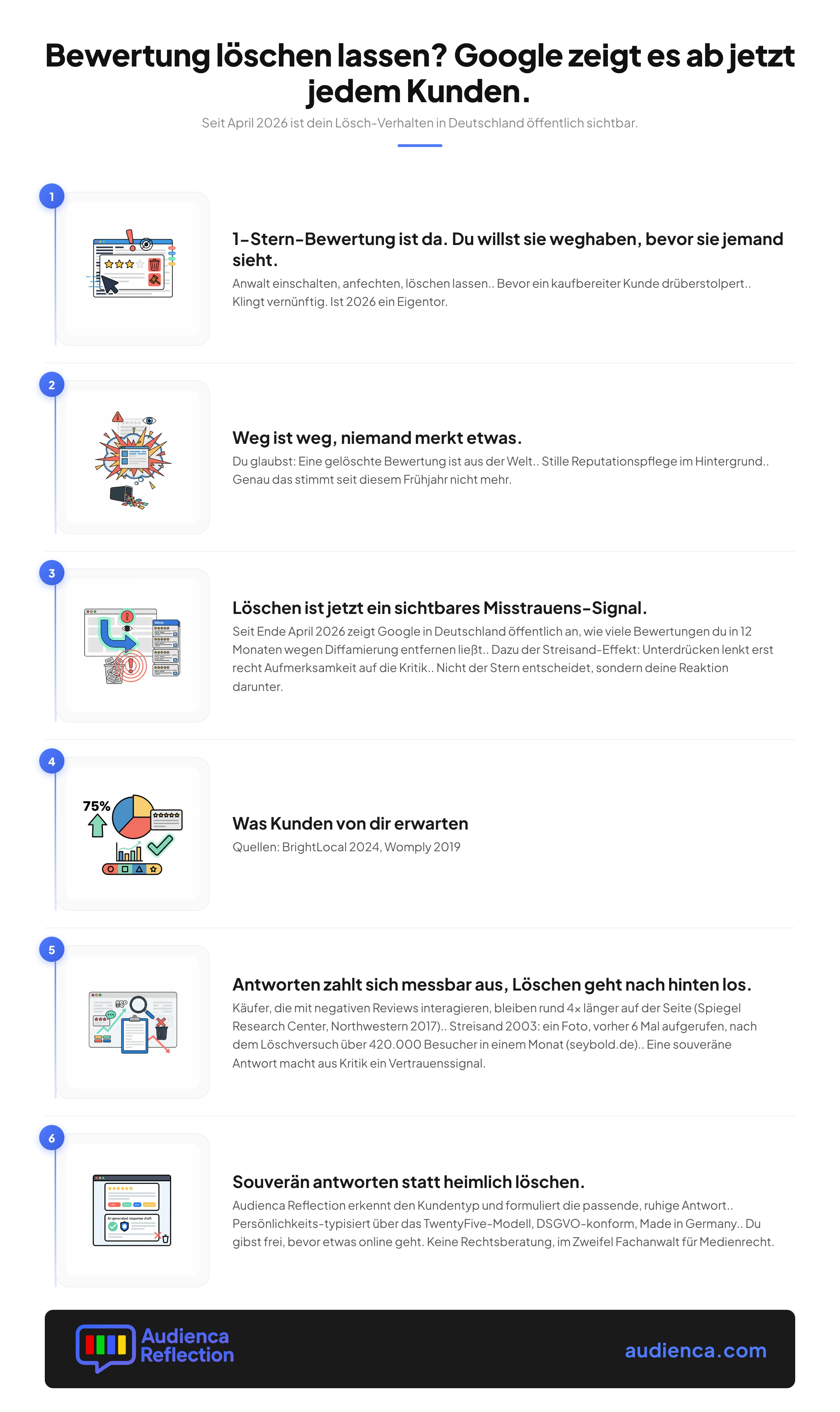
Imagine Google launching a transparency offensive in 2026. Under every business profile appears a counter: "X reviews removed after legal review in the last 12 months." What is a discreet background process today becomes a public signal, and trying to get a Google review removed could do more harm than good.
Google's New Transparency Offensive: Your Removal Behavior Becomes Visible to All
Such a counter would make visible how actively a business tries to remove criticism. Removing illegal content such as hate speech remains legitimate, but a high number of removed reviews sows distrust. The unspoken question: "What does this business have to hide?" The once sharpest weapon of reputation management would turn against its user.
The Streisand Effect 2.0: How Suppressing Criticism Puts It in the Spotlight
The Streisand effect: trying to suppress information unintentionally spreads it further. A high "removed" counter would be the digital catalyst. Customers would wonder what criticism is being systematically deleted, and an otherwise perfect 5-star profile with a high removal counter would appear less trustworthy than a 4.6-star profile with authentically answered critical comments.
A New Signal of Distrust: What a Public Counter Says About Your Handling of Criticism
Such a counter would be a clear signal of a weak error culture: a business that prefers the legal path of confrontation over constructive dialogue. Successful businesses use criticism to get better and to show publicly that they take their customers' concerns seriously. As we explain in our article on the 4.5-star advantage, a slightly imperfect profile with visible engagement actually convinces more customers than a flawless one.
The Better Strategy: How Replies Build Trust and Revenue
Instead of investing energy in removal, channel it into a proactive response strategy. Responding to criticism with composure is not a cost factor but a measurable revenue driver: manage your Google reviews, don't eliminate them.
What Customers Really Expect From You
Customers who write a negative review primarily want to be heard. The Local Consumer Review Survey regularly shows that an overwhelming majority expect a response, and over half expect it within 24 hours. Businesses that respond are perceived as more customer-oriented and trustworthy.
The Measurable Results of a Composed Response: Longer Dwell Time and Higher Purchase Intent
A well-formulated, public response works not only on the unhappy customer but on all the silent readers. They see that the business takes problems seriously and offers solutions. This increases dwell time on the profile and boosts purchase intent. A transparently handled conflict creates more trust than a flawless but potentially censored profile.
From Problem to Opportunity: How a Public Reply Turns Negative Criticism into a Strong Trust Signal
Every negative review is a stage. You can show a large audience how excellent your customer service is: an unhappy hotel guest who complains about the breakfast gets an empathetic reply that expresses regret and offers compensation, turning that negative touchpoint into proof of the highest service orientation. For the exact wording, see our article on 5 strategies for responding to negative reviews.
From Theory to Practice: How to Formulate the Perfect Response with Confidence
A good response strategy is the heart of modern reputation management. It is about communicating authentically, quickly, and solution-oriented, instead of having to get a Google review removed.
The Anatomy of an Effective Response: Thank, Regret, Offer a Solution
A professional response almost always follows a simple but effective structure:
- Thank and acknowledge: Thank the reviewer for the honest feedback. That signals openness.
- Express regret: Show empathy for the customer's negative experience. A simple apology can work wonders.
- Acknowledge the problem and offer a solution: Address the specific point of criticism and offer to continue the dialogue offline to find an individual solution.
- Positive close: End the response with a confident outlook to the future.
The Most Common Mistakes in Response Management and How to Avoid Them
The biggest mistakes are emotional or defensive reactions, copy-paste responses, and public discussions of details. Avoid justifications and blame; stay factual and solution-oriented. The goal is de-escalation and proof of professionalism. That includes strict GDPR discipline: never name employees, order numbers, or internal processes in public. Our guide on GDPR-compliant responses to Google reviews shows how to stay safe.
Intelligent Support for the Right Tone: How Audienca Reflection Helps You Respond Quickly and Professionally Based on Customer Types
In the hectic daily routine, there is often no time for individual responses. Tools like Audienca Reflection use advanced methods, similar to the practical use of NLP in review analysis, to analyze the customer type and tone of a review. Based on this analysis, the AI proposes personalized, psychologically sound response drafts. With Audienca's AI responses & TwentyFive, you get a high-quality draft in under 15 seconds that only needs approval, so every response hits the right tone without tying up resources. For the full playbook with ready-to-use templates, see our complete guide on how to respond to Google reviews.
Frequently Asked Questions
Is it still advisable at all to have reviews removed under the new Google rule?
Since the change in April 2026, removing reviews is only recommended in absolute exceptional cases, such as illegal content. Every removal is counted publicly and can be interpreted as an attempt to suppress criticism. A composed public response is almost always the better strategy for your business profile.
What exactly does Google now show publicly when I remove a review?
Google displays a visible notice in your business profile showing how many reviews were removed at your request in the last 12 months for defamation or illegality. This creates a new level of transparency: your handling of criticism becomes a public statement.
Does this transparency requirement apply to all businesses in Germany?
Yes, it affects all Google business profiles registered in Germany. The change aims to strengthen the authenticity of review profiles and counter manipulation, regardless of industry or company size.
How does the new removal notice affect the trust of potential customers?
A counter with many removed reviews can arouse distrust and give the impression that your business cannot tolerate criticism or has something to hide. An uncommented bad review often hurts less than the visible proof that you had it removed.
What about truly unlawful reviews? Should I no longer remove those either?
For clearly unlawful content such as insults, false factual claims, or threats, legal removal remains the correct path. However, note that even this removal appears in the public counter. The dilemma therefore exists even with legitimate requests, which is why a strategic assessment is crucial.
If removal hurts, how do I respond to criticism with confidence instead?
The best reaction is a timely, professional, and empathetic response directly under the review. Thank the reviewer for the feedback, apologize for the negative experience, and offer a constructive solution. This shows other potential customers that you take criticism seriously and act in a service-oriented way.