

The 5.0-Star Myth: Why Perfection Breeds Distrust
The optimal star rating for your business is not the flawless 5.0 that so many chase. For many owners, any rating below five stars feels like a personal defeat, a blemish on the digital business card. That pursuit of perfection is understandable, yet in the reality of online commerce it is a strategic mistake. Chasing a spotless record ignores a fundamental truth of consumer psychology: perfection is suspicious.
Experienced online shoppers have developed a trained eye for authenticity. A review profile with nothing but shiny 5.0-star reviews quickly looks "too good to be true." Questions immediately pop into the minds of potential customers: Are these reviews real? Were negative comments removed? Did the company ask employees or friends to rate it? That skepticism is poison for conversion. Instead of building trust, a flawless profile breeds distrust and can push customers toward a competitor with a more realistic, more "human" profile. The truth is, a few scratches on the paint do not just make your business more credible, they make it more likable.
The Hard Truth in the Data: Where Revenue Really Lies
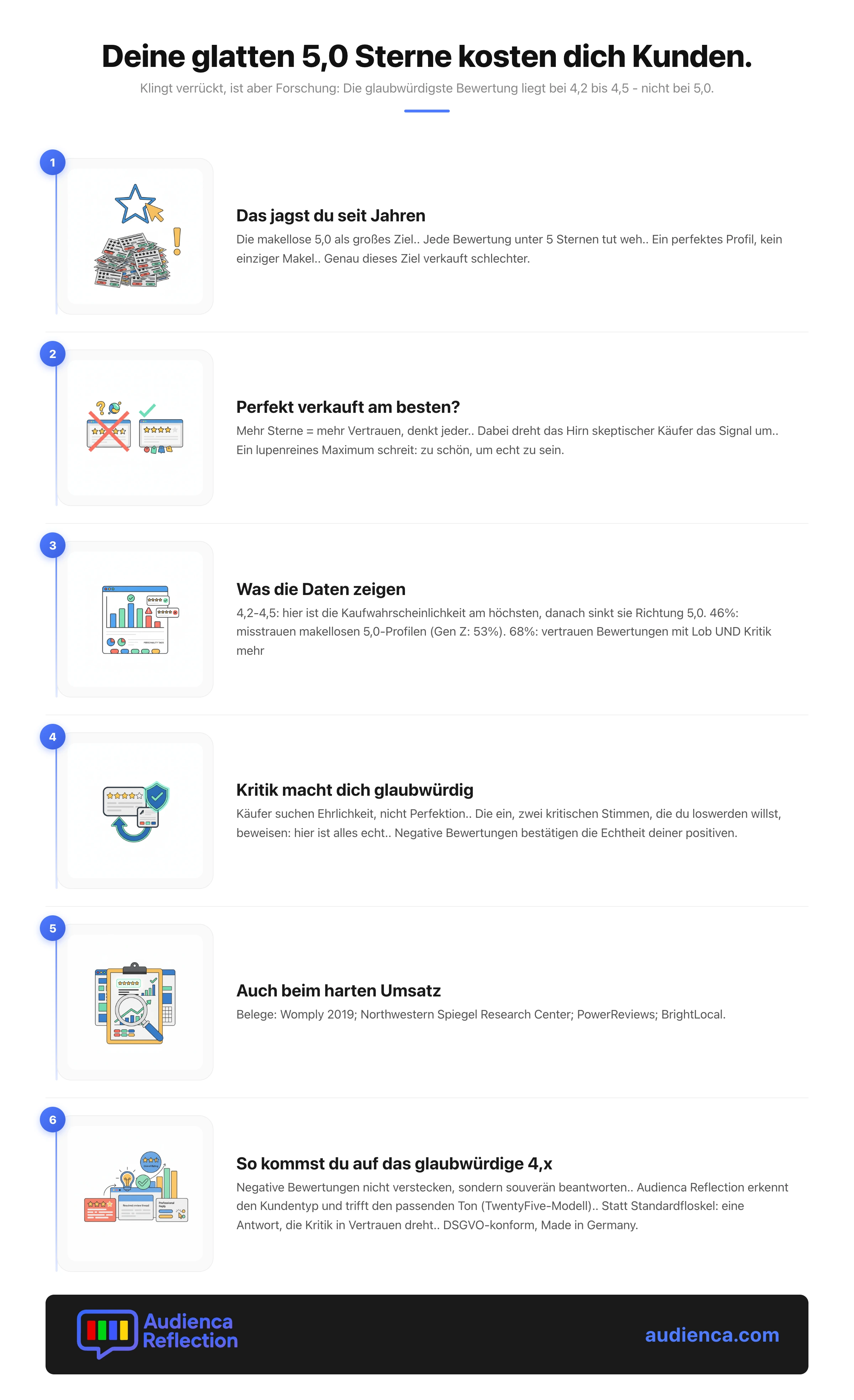
Gut feeling is a poor advisor in marketing. The hard truth about the effect of star ratings is best shown with data. Several landmark studies have analyzed the connection between average star rating and actual purchase probability, and they reach a surprising conclusion. The sweet spot of credibility, and with it the highest revenue peak, does not sit at 5.0 stars.
A widely cited study by the Spiegel Research Center at Northwestern University showed that purchase probability is highest in the corridor between 4.2 and 4.5 stars. Once the average rating climbs above 4.5 stars, conversion starts to decline again, because the skepticism described above sets in. This finding is a decisive paradigm shift for any business that takes reputation management seriously. The optimal star rating is therefore an imperfect but excellent value that radiates authenticity.
Exhibit B comes from another statistic: the majority of customers trust a profile with a mix of very good and some critical reviews significantly more than a purely positive one. Customers read negative reviews deliberately, not necessarily to disqualify a business, but to weigh the potential downsides and "worst-case" scenarios. If they find none, the overall picture looks censored and untrustworthy. A well-answered negative review can thus do more for your marketing than ten unanswered five-star praises.
From Flaw to Brand: Turning Criticism into Trust
The key is to understand negative feedback not as an attack but as an opportunity. Every critical voice is invaluable proof of the authenticity of all the other, positive reviews. It legitimizes your entire profile. The new currency in online reputation management is not perfection but visible, lived honesty. A composed handling of criticism shows potential customers more about your service culture than any glossy brochure. It proves that you listen, take problems seriously, and are willing to find solutions.
Turning criticism into trust requires a clear strategy. When you respond to a negative review, keep the following points in mind:
- Respond promptly: A reply within 24-72 hours signals that you take the feedback seriously and act proactively.
- Stay professional and personal: Avoid generic phrases at all costs. Address the reviewer, thank them for the open feedback (even when it stings) and sincerely apologize for the negative experience.
- Take responsibility, not excuses: Do not explain why the customer is wrong. Even when the criticism is only partly justified, show understanding for their perspective.
- Offer an offline solution: Move the detailed problem-solving out of the public eye. Offer direct contact by email or phone to resolve the case individually. That shows every silent reader your willingness to help, without exposing sensitive customer data.
By responding professionally and solution-oriented, you turn a potential image problem into an impressive proof of excellent customer service. For a step-by-step playbook that covers every scenario, see our complete guide on how to respond to Google reviews. And if you are tempted to remove critical reviews instead, read why that is almost always the wrong move in our article on getting Google reviews removed.
The Practical Solution for a Credible and Optimal Star Rating
The goal of modern reputation management is therefore not to desperately get a bad review deleted, but to engage with it visibly and professionally. Many SMBs fail at the execution in daily practice. There is a lack of time, staff, or know-how to respond to every review individually, on-brand, and above all GDPR-compliant. Manual processes are error-prone and time-consuming. When you have hundreds of Google reviews to answer, it quickly becomes a burden.
This is where smart technology comes in. The solution lies in intelligent automation that combines efficiency with individuality. Tools like Audienca Reflection were built exactly for this challenge. They use advanced AI to create the right response draft for every customer type and every kind of criticism. Their real strength shows in the practical use of NLP and psychological profiling, which analyzes the tone and intent of a review. Within seconds, a draft is generated that not only sounds professional and empathetic but also respects all legal frameworks, especially the GDPR. This ensures no sensitive data is ever disclosed.
These AI-generated responses are not soulless text blocks but a solid foundation that an employee only needs to briefly review and approve with a personal touch. The process of responding to reviews drops from minutes to seconds. Criticism is thus confidently turned into proof of trustworthiness, and managing your online reputation goes from an annoying chore to a strong marketing instrument.
Frequently Asked Questions
Why is a perfect 5.0-star rating less credible than 4.5 stars?
A flawless 5.0 rating looks "too good to be true" to many potential customers and raises suspicion of bought or fake reviews. A slightly imperfect average between 4.2 and 4.5 stars, by contrast, signals authenticity and honesty, because it paints a realistic picture with praise and occasional criticism. The claim "your clean 5.0 stars are costing you customers" is based precisely on this psychological effect.
Doesn't a single 1-star review always hurt my business?
Not necessarily. A single bad review can actually increase the credibility of all your positive reviews. It proves that your profile is genuine and that you do not censor criticism. What matters is a composed, professional response that demonstrates your commitment to customer satisfaction and resolves the problem.
Should I deliberately aim for a rating between 4.2 and 4.5?
Your goal should always be excellent service, not a specific average score. The optimal range of 4.2 to 4.5 stars emerges organically when you do not delete or hide criticism but use it as a chance for visible customer service. It is about letting go of perfectionism and betting on authenticity through confident management of all reviews.
Does "the more stars, the better" no longer apply at all?
It only applies up to a point, because studies clearly show that purchase probability is highest between 4.2 and 4.5 stars and declines afterwards. Beyond a certain point, the perception of perfection flips into skepticism. The reality is: your clean 5.0 stars cost you customers, because they generate less trust than a more realistic, slightly imperfect profile.
How can a negative review actually strengthen the effect of my positive ones?
Negative reviews serve as social proof that your profile is real and not manipulated. When a potential customer sees that critical voices are allowed and answered professionally, trust in the authenticity of the positive reviews rises enormously. This transparency makes your entire profile more credible and more convincing.
Do so many customers really distrust a flawless 5.0 rating?
Yes, the data is clear and backs the core claim "your clean 5.0 stars are costing you customers." Studies show that almost half of all consumers distrust a perfect 5.0 profile, and among Gen Z it is over 53 percent. Customers deliberately look for critical voices to form a complete and honest picture of a business.